

Higher Certificate in Canine First Aid
This veterinary approved and externally accredited online course is written and designed by a qualified registered veterinary nurse and clinical animal behaviourist. It has been designed for pet professionals, fulfilling Continuing Professional Development (CPD) requirements. However, it is suitable for pet owners too.
Written with the benefit of practical veterinary experience and informed by current veterinary best practice standards.
Learning outcomes:
- Gain the skills to identify and effectively respond to various first aid scenarios that may arise.
- Acquire the knowledge necessary to conduct a safe assessment of the dog's condition.
- Learn the proper techniques for administering basic first aid treatments and providing immediate care while awaiting veterinary assistance.
- Explore fundamental principles of first aid, emphasising safe handling practices and updated CPR protocols, along with additional essential skills.
This course includes:
- 8 modules
- Bitesize lessons
- Access on all devices
- Lifetime access
- Video demonstrations
- Downloads
- No assessments, just quizzes
- Certificate of completion
- CPD transcript
- Tutorial & technical support
- Unique 'Accredited First Aider’ graphic
- First aid quick reference e-book
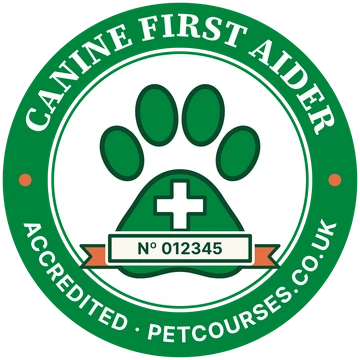
Your First Aider badge:

Accredited Canine First Aider
When you complete this course you'll receive a personalised digital badge showing that you have completed an accredited canine first aid course, as an Accredited Canine First Aider. You can share it on social media, add it to your CV or use it on your website.
What you can do with it
- Your websitePaste the code from your account. It links to a page that shows your badge is real, and it updates by itself.
- Your CVAdd your badge number, so an employer can check it on our website.
- Your email signaturePut the web size under your name in the emails you send.
- Social mediaShare it on Facebook, Instagram or LinkedIn to show your new badge.
A look inside the course:
Who this course is for:
- Dog owners
- Dog walkers
- Dog groomers
- Dog carers / sitters
- Dog trainers
- Dog kennels / hotels
- Animal behaviourists
- Pet professionals
Before you enrol:
There are no specific requirements for this course. This certificate course has been designed to help the student develop new skills and enhance their knowledge. You can enrol on this courses without any animal related qualifications, although a reasonable standard of literacy is required.
- Text Size: Make the words bigger on every lesson: choose Standard, Large or Larger from the Aa button at the top of the page.
- Light and Dark Colours: Dark colours are easier on the eyes in low light. Switch from the same Aa button; the site remembers your choice.
- Reading Ruler: Highlights one line at a time to help maintain focus. Toggle it on/off from the toolbar at the top of each lesson.
- Table of Contents: Longer lessons have a Contents button in the toolbar to jump straight to any section.
- Reading Time: Each lesson shows an estimated reading time in the toolbar so you can plan your study sessions.
- Notes: Jot down key points and questions in your own words beside any lesson. They save as you type, and you can download them all as a PDF.
- Help in Every Lesson: Search our help articles, or ask your tutor or our technical team, without leaving the lesson.
- Auto-Generated Subtitles: Available on all of our videos (approximately 95% accurate). Turn them on with the CC button in the video player.
- Video Transcripts: Text versions of video content with timestamps, allowing you to follow along or revisit specific sections.
- Adjustable Playback: Video quality adjusts automatically to your connection. Use the cog for manual control, or change the playback speed to suit your pace.
- Feature Boxes: Key information is presented in visually distinct boxes, helping break down content and improve focus for neurodivergent learners or those with reading difficulties.
- Colour Contrast: Our course materials use high-contrast colour schemes to aid readability, particularly for learners with colour blindness or visual impairments.
- Downloadable Resources: Slides and supporting materials accompany webinars, so you can follow along and refer back at your own pace.
The course recognises that the veterinary surgeons act 1966 restricts the diagnosis and treatment of an animal by another person other than a qualified and registered veterinary surgeon. However any lay person can carry out first aid in an emergency situation.
This course is NOT designed to replace veterinary treatment and attention. For all first aid cases, a veterinary surgeon should be contacted as soon as possible.
About the instructor:

Course curriculum:
About 2h 50m is the time to watch the videos, read each lesson and answer the quizzes. Reading is timed at 130 words a minute, as course material is read to be learnt, and quizzes at about 45 seconds a question, so you may take a little more or less.
This course counts for 8 CPD hours. That also counts the time spent on the suggested tasks, further reading and research through the links in the lessons, and the assessments, so expect to spend longer than the videos and reading alone.
-
Intro to First Aid & Patient Assessment
- Introduction from Caroline Updated
- The basic principles of first aid
- What to include in a first aid kit
- Hand hygiene, safe handling and restraining techniques
- Assessing and examining the patient and measuring the vital signs
- Mucous Membranes and Capillary Refill Time
- Suggested Tasks
- Multiple Choice Questions
-
General First Aid Situations
- Haemorrhage and Locating the pressure points
- Dealing with clinical shock
- General Wounds
- Poisoning
- Bites and Stings Updated
- Suggested Tasks
- Multiple Choice Questions
-
CPR, Neurological & Recognition of Pain
- Cardio-Pulmonary Arrest (CPA) and Performing Cardio-Pulmonary Resuscitation (CPR)
- Dealing with fits
- Recognising pain and its effect on the patient
- Suggested Tasks
- Multiple Choice Questions
-
More General First Aid Situations
- Burns and Scalds
- Hyperthermia
- Hypothermia
- Ticks - recognition and safe removal
- Suggested Tasks
- Multiple Choice Questions
-
General Intestinal Conditions, Electrocution & Drowning
- Gastric dilation-volvulus (GDV)
- Vomiting
- Diarrhoea & Dehydration
- Electric Shocks & Electrical Burns
- Drowning / Near Drowning
- Suggested Tasks
- Multiple Choice Questions
Student reviews:
- Students felt significantly more confident handling emergencies after learning to recognise symptoms and provide appropriate first aid
- Reviewers valued the mix of videos, diagrams and bite-sized modules that made complex information easy to understand and remember
- Professionals in dog care roles praised how the course gave them practical knowledge they could immediately apply in their work
- Students appreciated being able to study at their own pace flexibly, returning to sections whenever they needed to refresh their understanding
Based on 144 published student reviews across all star ratings for this course.

Taylor N.
VerifiedI think the course was very good. Structured in a way that is easy to learn, and not overwhelming.
I think the whole course was good, there is nothing i could note to change.

Joanne C.
VerifiedExcellent course
A course that covers a brilliant range if topics , and easy to understand. Would recommend.

Ian B.
VerifiedExcellent and informative
Really enjoyed this course, was full of easy to follow guides and information

Michael B.
Verifiedxcellent Pet First Aid Course – Practical and Informative
I found the course very informative and useful, particularly for working with dogs on a daily basis. It covered a wide range of common emergencies and helped me understand how to recognise signs of illness and injury and provide appropriate first aid. I feel much more confident about dealing with an emergency and knowing when veterinary attention is required. The course has also given me useful knowledge that I can apply in my dog-walking and pet-care work. Overall, I would recommend the course to anyone who regularly works with or cares for dogs.

Adriana S.
VerifiedHighly recommended
This was a well-structured and easy-to-follow course with practical information that can be applied in real-life situations. The content was clear, the pace was appropriate, and I particularly enjoyed learning the essential first aid techniques for dogs. As someone with a background in Animal Science who works in pet care, I found the course very valuable for improving both my professional knowledge and confidence when dealing with emergencies. I would definitely recommend it to anyone working with animals or to dedicated pet owners, as it provides practical skills that could make a real difference.

Sarah P.
VerifiedAnother fantastic course
I've lost count of how many of Caroline's courses I've completed. They're all fantastic and this one is no exception. Very detailed and well thought out course content with clear instructions on how to manage veterinary first aid situations.
Keep growing — CPD courses chosen for you…



Online Course · Higher Certificate
Higher Certificate in Canine Health & Well-being
by Caroline Clark
- 10 CPD hours
- Intermediate
- 9 Modules

Online Course · Higher Certificate
Higher Certificate in Canine First Aid for Veterinary Receptionists
by Caroline Clark
- 8 CPD hours
- Intermediate
- 10 Modules

Online Course · Certificate
Certificate in Canine Handling & Understanding Communication Signals
by Caroline Clark
- 5 CPD hours
- All levels
- 6 Modules
CPD hours include the time for downloads, videos, links and suggested tasks as well as the lessons. How do we calculate CPD hours?