Providing the Perfect Litter-tray for Your Cat
 Kittens are easy to litter train if the set-up is optimal
Litter trays are an obvious requirement for indoor cats, although cats that have outside access may also choose to use a litter tray in the house from time to time or require one during periods of confinement, perhaps after a surgical procedure, or in winter, when the ground is frozen. Therefore choosing the ‘perfect’ litter tray for your cat is important.
Because the cat is a fastidious character, they usually tend to be quite discerning and particular about their toileting arrangements. Things such as its location, size, depth, and the type of substrate (litter) provided can play a role in how a cat feels about their litter tray.
In many cases, cats have to put up with a less-than-ideal setup because we humans tend not to give it as much thought as we should. Yet, house soiling problems are very commonly associated with poor litter tray management so getting things right from the onset will help to keep a cat happy and prevent house soiling problems.
General Advice
Fortunately, there has been a fair amount of research and interest in litter tray provision so we do have some useful information to help you when choosing the right litter tray for your cat. Here’s some top advice:
Location
- Choose a private location that is safe, quiet, and away from busy areas.
- Avoid placing close to a window, door, or cat flap where a cat might be disturbed and feel insecure.
- Trays must be well away from food and water. Would you want to eat your lunch looking at the toilet?!
Cleanliness
- The cat is a fastidious animal so daily removal of faeces and spot cleaning is important.
- A build-up of urine and faeces – especially from other cats is a common cause of litter tray aversion and house soiling.
- A full and thorough clean out and complete change of litter should be done at least once a week, remembering to avoid strong-smelling disinfectants and those that are poisonous to cats (e.g. phenols).
The Type of Litter (substrate)
- Litter should be free from scents. Pleasant-smelling litter appeals to us but not the cat!
- Experts advise that cats tend to prefer clumping and fine substrates over heavier, coarse varieties (Carney et al. 2014).
- A depth of three to four centimetres is ideal for burying deposits.
- Avoid tray liners as these tear and snag when the cat is covering their waste. Plus, they can hold urine which makes it unpleasant for the cat to stand on.
Size and Number of Trays
- Studies suggest that larger litter trays are favoured over the typical standard-length (Guy et al. 2014). Cats like to be able to move around to get into a comfortable position before toileting so choose one that is at least 1.5 times their length (from the tip of their nose to the base of their tail).
- Cats do not like sharing and this generally applies to their litter tray. The general rule of thumb is a minimum of one tray per cat and if there is room enough for one extra – all the better.
- Space litter trays well apart. Lining them up side-by-side is just like one big litter tray and does not afford privacy.
Scientific Snippet: It has been reported that cats living together in a multi-cat household showed increased frequencies of friendly behaviour when the number of litter boxes (and food stations) was increased (Finka 2022).
References
Carney, H.C. et al. (2014) ‘AAFP and ISFM guidelines for diagnosing and solving house soiling behavior in cats’, Journal of Feline Medicine and Surgery, 16(7), pp. 579–598. doi:10.1177/1098612×14539092.
Finka, L.R. (2022) ‘Conspecific and human sociality in the domestic cat: Consideration of proximate mechanisms, human selection and implications for cat welfare’, Animals, 12(3), p. 298. doi:10.3390/ani12030298.
Guy, N.C., Hopson, M. and Vanderstichel, R. (2014) ‘Litterbox size preference in domestic cats (Felis catus),’ Journal of Veterinary Behavior, 9(2), pp. 78–82. doi:10.1016/j.jveb.2013.11.001.
All this information features in my book ‘A Professional’s Guide to Feline Behaviour’ published by CRC Press (part of the Taylor and Francis Group). For more details about the book and to sneak a peek see below:
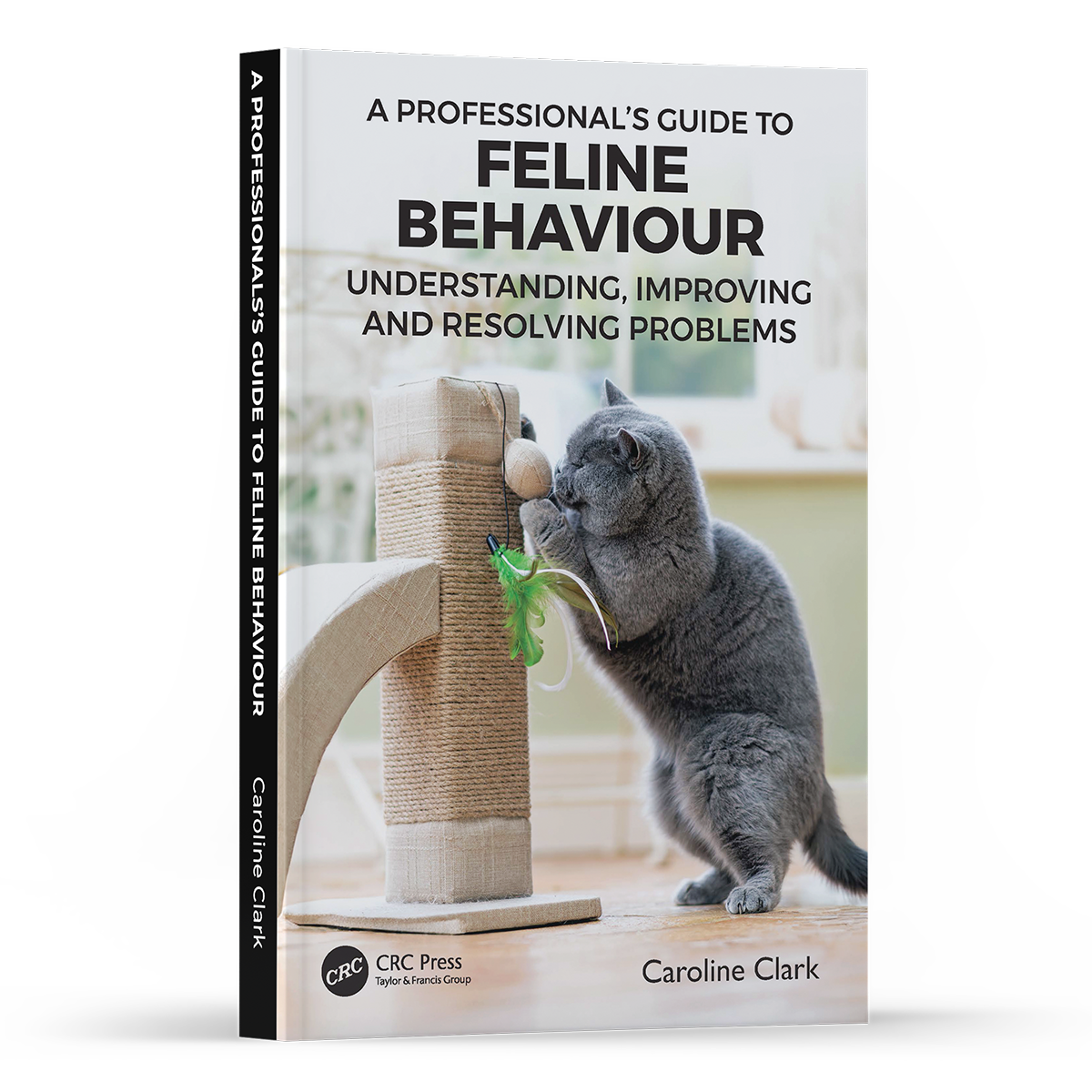
A Professional's Guide to Feline Behaviour
Understanding, Improving & Resolving Problems
A Professional's Guide to Feline Behaviour is an invaluable resource for the feline professional, yet written in such an accessible way that it would be of interest to anyone who shares their life with a cat and wants to gain a deeper understanding of their behaviour. The book is presented in easy-to-navigate sections, each packed with practical advice and the colour illustrations, tables and graphics throughout make it approachable for every type of reader.