Guide to Crate Training
 Photo: Rufus, courtesy of Amy Clark
Crates come in many different designs but they must be large enough for the dog to move around and stand upright comfortably. Due to a dog’s social nature, the crate should not be placed in an isolated location and they must never be used for ‘time out’ — otherwise a negative association may develop.
The Benefits of Crate Training
- They can be used as the dog’s safe haven.
- They can be used for health and safety purposes when there are children/toddlers in the home.
- For safe car travel and transportation.
- They can help habituate a dog to being confined (for example, for hospitalisation purposes).
A crate should represent a safe and secure place to rest, so make sure it is comfortable and inviting. However, a dog cannot be expected to be confined for extended periods, when they are hungry, in need of the toilet, or require exercise. Everyone in the family must respect the crate as the dog’s safe haven and children should be taught to give the dog peace and quiet when they are there.
The Training Steps
- Introduce a dog to the crate as early as possible. If you begin when they are puppies it will be easier, but older dogs can be taught too.
- Place it in a quiet, but not completely isolated, area and leave the door open.
- Make the crate as comfortable as possible – it can help to place it where your dog usually sleeps.
- Partially covering it with a blanket can help it feel more like a den.
- Use familiar and comfortable bedding.
- Consider using dog appeasing pheromone products on the bedding or in a diffuser close by to create a calming environment.
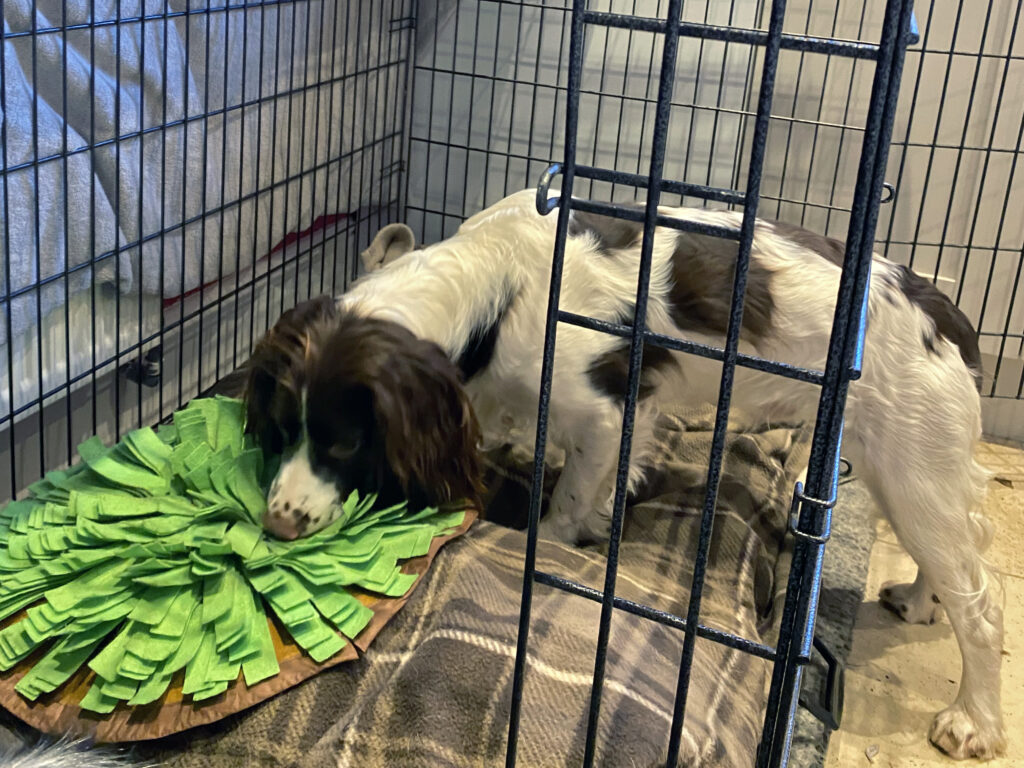
- Place treats, toys or meals in the crate so that the dog is motivated to enter.
- Never force them inside.
- Reward a dog for entering the crate themselves.
- Sit next to the crate, calmly and quietly, after they have had a play session or when they are tired and resting.
- Encourage the dog to go in the crate after exercise when they might be feeling tired.
- A comfort blanket/mat that has been used to teach a ‘Relax on a Mat’ can be placed inside — but not if they already have a negative association with the crate.
- When a dog is comfortable entering the crate voluntarily, desensitise them to relaxing inside with the door shut.
- When they are engaged in a self-reinforcing activity (interactive feeder or a toy), close the door very briefly (for one to two seconds).
- Open the door and praise them.
- Very gradually (second by second) increase the time they are inside with the door closed but do not leave them alone.
- If they are resting, you can sit quietly close by, reading or doing something that makes you feel relaxed.
- Once they are relaxing and not objecting to being in the crate with the door closed, leave the room very briefly but make sure you are in sight to begin with.
- Return and open the crate door, praising and rewarding as before.
- Gradually increase the time with in-view absences, varying the duration from short (two to three seconds) to slightly longer (five to eight seconds) and so on.
- Progress to very brief out-of-view absences. A baby gate can be useful so the door to the room can remain open, making it feel less isolating.
- Gradually increase the time they are left alone in this way.
- Remote cameras can be used to check the dog’s reactions — make sure you can return before they show any signs of distress.
Training in this way ensures that your dog does not become frightened of being confined.
Never leave a dog to cry or become distressed, as this will only create negative associations with the crate and be counter-productive to training.